Real Amazon Wholesale Profit Margins: What You Actually Net After Every Fee
Most content about Amazon wholesale quotes 20 to 30 percent margins. That number is calculated before Amazon takes its cut. Here is what you actually keep once every fee is accounted for, with a real worked example.
The 20 to 30% margins you see online are gross, before Amazon takes its cut. After referral fees, FBA fees, placement fees, prep and inbound shipping, the honest floor for a legitimate wholesale product is around 10% net on the selling price. The best ones hit 15 to 25%. Anything under 10% isn’t worth sourcing at scale.
Why the numbers you see online are wrong
Search "Amazon wholesale profit margin" and you will find the same answer everywhere: 20 to 30 percent. Some sources say even higher. Almost none of them specify what that number actually means.
In most cases it is gross margin before Amazon fees. The calculation is simple: selling price minus product cost, divided by selling price. If you buy a product for $10 and sell it for $20, that is a 50% gross margin. If you buy it for $14 and sell it for $20, that is 30%. The math is easy and the number looks great.
The problem is that between you and the customer sits Amazon, a prep center, a shipping company, and potentially two separate freight bills. By the time every cost is subtracted, the number that actually hits your account is very different from what the headline figure suggests.
After 9 years on the US marketplace and analyzing thousands of products, the honest floor for a legitimate wholesale product is around 10% real net margin on the selling price. That is the minimum I look for. Good products beat it. Products below that threshold are generally not worth sourcing at scale.
This exact gap, before-fees versus after-fees, is also how done-for-you automation programs inflate their advertised ROI. Same math, same missing costs.
Every fee you actually pay
Here is the complete cost stack for an Amazon wholesale seller using FBA. None of these are optional. Every single one applies to every unit you sell.
1. Referral fee
Amazon charges a referral fee on every sale, calculated as a percentage of the total selling price including shipping. The rate depends on category. Most everyday product categories sit between 8% and 15%. Grocery and health products are typically 8%. Toys, tools, and home goods are often 15%. This comes off the top before anything else.
2. FBA fulfillment fee
If you use Fulfillment by Amazon (which you should for wholesale, see FBA vs FBM for wholesale), Amazon charges a per-unit fulfillment fee for picking, packing, and shipping the order to the customer. This is based on the product's size tier and weight. A standard-size item under a pound might cost around $3.50 to $4.50. Larger or heavier items cost significantly more.
3. Inbound placement fee
Introduced in 2024, this is a charge for distributing your inventory across Amazon's fulfillment network. When you send inventory to a single receiving warehouse, Amazon may charge a per-unit fee to move it to the appropriate fulfillment centers. Older wholesale guides do not mention this because it did not exist when they were written. It is real, it applies now, and it needs to be in your calculations.
4. Prep center fee
Unless you handle fulfillment yourself (not recommended at wholesale volume), you pay a prep center to receive your inventory from the supplier, inspect it, apply Amazon barcodes, package it to Amazon's requirements, and ship it into FBA warehouses. Pricing varies by prep center but typically runs around $0.50 to $1.50 per unit. This is per unit, on every order, every time.
5. Inbound shipping: supplier to prep center
The cost of getting your inventory from the distributor to the prep center. This depends on the supplier's location, the weight of the order, and whether you are shipping by pallet or parcel. For most standard wholesale orders, budget somewhere between $0.30 and $1.00 per unit depending on order size.
6. Inbound shipping: prep center to Amazon
The prep center charges to ship your prepped inventory into Amazon's FBA warehouses. This is usually included in the prep center quote as a per-pound or per-unit line item. It is a separate cost from the supplier-to-prep leg.
Storage fees
Amazon charges monthly storage fees per cubic foot of space your inventory occupies. For standard-size items these are relatively low outside of Q4. If a product sits unsold for too long, long-term storage fees kick in. This is why velocity matters as much as margin. A slow-moving product at 15% margin can be worse than a fast-moving one at 12%.
A real worked example
Here is what the full cost stack looks like on a real product. Numbers are representative of a standard-size item in a 15% referral category.
| Item | Notes | Amount |
|---|---|---|
| Selling price | Current Buy Box price | $22.00 |
| Product cost | Wholesale price from distributor | −$11.00 |
| Referral fee | 15% of selling price | −$3.30 |
| FBA fulfillment fee | Standard size, ~12oz | −$4.00 |
| Placement fee | Amazon inbound placement (2024) | −$0.45 |
| Prep center fee | Receive, label, box, ship | −$1.00 |
| Inbound shipping | Supplier to prep + prep to Amazon | −$0.80 |
| Net profit per unit | What you actually keep | $1.45 |
| Net margin | $1.45 ÷ $22.00 | 6.6% |
That product does not meet the 10% floor. It gets cut. Not because 6.6% is disastrous on paper, but because any fee increase, any price drop from a competitor, or any storage buildup turns it negative. There is no buffer.
Now adjust the selling price to $25 with the same product cost:
| Item | Notes | Amount |
|---|---|---|
| Selling price | $25.00 | |
| Product cost | −$11.00 | |
| Referral fee | 15% | −$3.75 |
| FBA fulfillment fee | −$4.00 | |
| Placement fee | −$0.45 | |
| Prep center fee | −$1.00 | |
| Inbound shipping | −$0.80 | |
| Net profit per unit | $4.00 | |
| Net margin | $4.00 ÷ $25.00 | 16% |
Same product, same supplier cost, same FBA fees. The selling price is $3 higher and the net margin goes from 6.6% to 16%. This is why Buy Box price stability matters so much when you analyze a product before buying. A product with a stable $25 Buy Box is a fundamentally different business from the same product with a $22 Buy Box, even though the underlying wholesale price is identical.
Tools like SellerAmp calculate the full fee stack for any product in seconds. You enter the Buy Box price and your product cost, and it outputs your net margin and ROI. Here's the full walkthrough if you want to see exactly how to read those numbers. Run it before you commit to any order. And use Keepa to confirm the Buy Box price has been stable over the past 6-12 months, not just today.
Is Amazon wholesale profitable at a 10% margin?
Ten percent sounds thin. It is not, once you understand that wholesale is a volume and velocity game. Here is what it looks like as monthly revenue grows:
The goal is not to find one product with a 10% margin. The goal is to build a catalog of 20 to 30 products where the average net margin is 10 to 15%, and the total monthly revenue is high enough that the net income is meaningful. That is how this business model actually works.
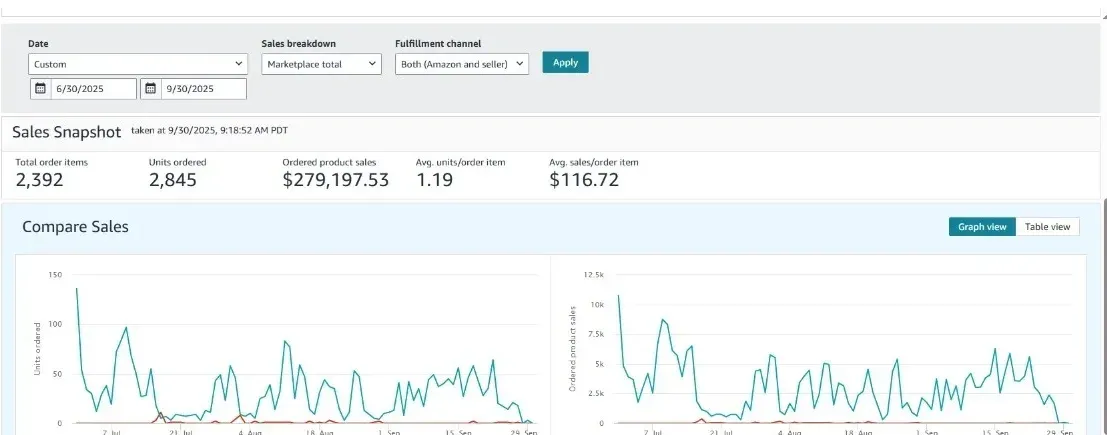
One of my clients generated $1.79M in sales in 2024. At a blended net margin in that range, that is real money, not because any single product was exceptional, but because the catalog was large enough and consistent enough to compound month over month.
What makes a product beat the 10% floor
The 10% figure is a floor, not a ceiling. Products can and do hit 15, 20, even 25% net margin. Here is what tends to separate them:
- Higher selling price. Fixed fees like FBA fulfillment and prep center costs represent a smaller percentage of revenue on a $40 product than on a $15 one. A $15 product with a $4 FBA fee has that fee eating 26% of revenue. A $40 product with the same $4 fee has it eating 10%.
- Lower referral fee category. An 8% referral fee vs a 15% referral fee on the same product is a 7-point swing in margin before anything else changes.
- Fast velocity. Products that sell quickly keep storage costs near zero. Products that sit for months accumulate storage fees that eat into margin steadily.
- Stable Buy Box price. A product whose Buy Box price has been consistent for 12 months has a much lower risk of margin compression than one where the price has been dropping.
- Fewer FBA sellers competing. More sellers at the same price means your Buy Box share is smaller, which means slower velocity, which means more storage cost. A listing with 3 FBA sellers at a stable price is structurally better than one with 15.
Once you are running multiple products, you need a single view of what each one actually nets per month after all costs, not a spreadsheet estimate. Sellerboard pulls your Amazon data automatically and shows real net profit per product, accounting for every fee. It is how you know which products to reorder and which ones to drop.
The ROI number most sellers use
While net margin measures profit as a percentage of selling price, most wholesale sellers also track ROI on product cost: how much profit you make relative to what you spent on the inventory itself.
A minimum ROI of 15 to 20% on product cost is a common threshold. At 15% ROI, for every $1,000 you invest in inventory, you get back $150 in profit after all costs once the inventory sells. That translates to roughly 10-12% net margin depending on the product price.
Use both numbers. Net margin tells you how efficient the product is. ROI tells you how efficiently you are deploying your capital. Profitable on paper does not mean cash-healthy though, see the real timeline from paying a supplier to getting paid.
Before placing any wholesale order, run both calculations. If you are not sure how to do this quickly on a price list, the price list analysis guide walks through the exact process.

The mentorship covers fee calculation, price list analysis, and product research in detail, applied to your actual suppliers. Book a call and we run the numbers on your specific situation together.